
GROW TODAY.
BUILD FOR TOMORROW.
The model that built many specialist consulting and technology businesses won't be enough for what comes next.
Growth gets harder when the founder still drives every relationship, demand is unpredictable and hiring only happens once the pressure is already showing.
The Godwin Austen Growth Readiness Diagnostic gives you a clear read on which of these pressures is doing the most damage to your growth right now.
Built From Direct Experience.
The experience behind Godwin Austen comes from building, growing, selling into and operating specialist businesses ourselves.
This matters more than ever because the challenges facing most expertise-led firms are not being solved by applying a generic growth playbook.

£1bn+ Sales
Software and consulting sales experience across the Godwin Austen team

Multiple Exits, MBOs & Acquisitions
Direct experience of building, buying, selling and integrating businesses
Multi-Sector
Expertise
Experience across EPM, data and analytics, engineering and technical consulting, wealth management, AV, workplace technology and cybersecurity.

Cross-Functional
Leadership
Decades of commercial and operational leadership spanning sales, delivery, people, operations and growth.

Specialist Network
Access
Founders, shareholders, advisers and practitioners who contribute to client work when their experience is relevant.
Where Growth
Starts to
Break Down.
The wider problem in most cases is how the business creates demand, qualifies opportunities, makes decisions, adds capability and delivers the work once it is won.
The Founder Is Still the Commercial Engine
Important opportunities, major client relationships and difficult decisions still land on your desk. The team may be capable, yet progress depends on one person's time, judgement and availability.
Leadership Cannot Trust
the Pipeline
There may be plenty of deals in the CRM, but leadership is not confident what is real, what will close or when. Weak qualification consumes sales, presales and management time on opportunities that should have been challenged much earlier.
Marketing Activity Without Commercial Momentum
Referrals, vendor introductions and personal networks continue to do too much of the work. Marketing and sales may both be active, but the system does not reliably create, nurture and convert new demand.
Demand and Capacity Are Out of Sequence
Capability gets added after the pressure is already urgent, or expensive people are hired before there is enough evidence of future demand. Either way, growth becomes harder to plan.
Leadership Lacks Authority and Commercial Direction
Senior people are busy, but ownership, priorities and commercial accountability remain unclear. When progress stalls, the founder gets pulled back in.
Scale Is Adding Complexity Faster Than Value
Revenue may be increasing while margin, cash flow, predictability and transferability remain under pressure. A larger company can simply become a more demanding version of the business you were trying to move beyond.
You've probably recognised one or two of these already. The diagnostic tells you where to focus first.
Start With the Problem,
Then Build the Right Combination Around It.
A weak pipeline may begin with an unclear proposition, delivery pressure may expose a workforce problem and founder dependency may actually be a leadership or operating-model issue.
This is why we identify the constraint first, then combine the right mix of capabilities around it:
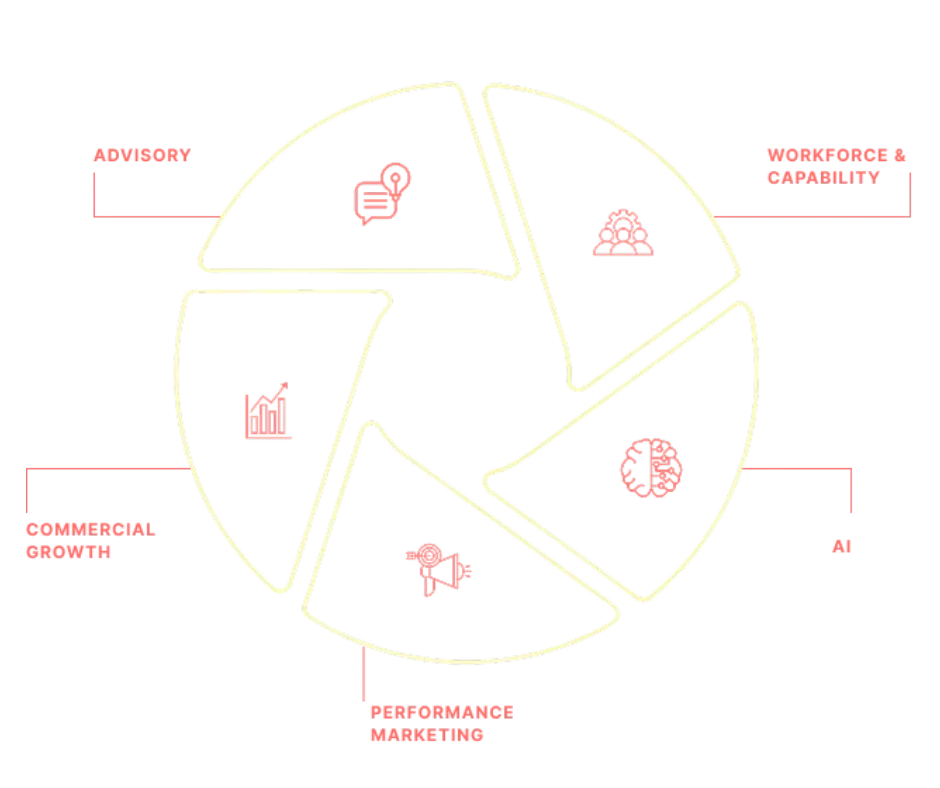
The diagnostic is the fastest way to see which of these matters most for your business right now:
A Real-World Example:
Taking Oxford Summer Courses From
Uncertainty to a Trusted Forecast.
By 2022, Oxford Summer Courses had around 600 summer beds still unsold, representing roughly £600,000 of committed capacity.
The problem was that sales, marketing and delivery were each working from a different picture of demand, so nobody had real confidence in what the pipeline was actually telling them.
Our team rebuilt the commercial operating model around Salesforce so all three functions shared one view of the pipeline, its qualification and what it meant for forecasting.
Within a year, every planned bed had been sold, and the business was sourcing additional capacity with genuine confidence behind the numbers, ahead of a successful 2025 exit.
“Within a month, lead quality improved and conversion rates soared. Instead of lagging behind our sales target, we exceeded it, to the point that we now have a waiting list of students wanting to attend. This has provided a more consistent and predictable source of revenue for the business.”
Simon Flint,
Head of Sales & Admissions at Oxford Summer Courses

FAQs.
How long does the diagnostic take?
About five minutes to complete 12 focused multiple-choice questions to get one clear result.
What do I actually get?
An instant read on which of the common growth constraints is creating the most friction in your business right now.
Do I have to book a call afterwards?
No. The diagnostic stands on its own as a first look into your business model. Most businesses find it useful to talk through the result afterwards, but that's an option, not a requirement.
Is this relevant to my industry?
The questions apply across specialist consulting and technology businesses across various industries, and your result reflects your own answers, not a generic benchmark.
Find the Constraint & Decide What to Fix First.
Growth problems do not stem from one function.
A weak pipeline affects hiring. Delivery pressure affects sales. Founder dependency slows decisions across the business.
The Growth Readiness Diagnostic will help you:
Identify where growth is being held back
Understand how that constraint is affecting the wider business
Decide where to focus first
Answer 12 focused questions in around five minutes and receive an immediate result.
Prefer To Talk It
Through First?